Samsung Health HRV: where it shows and whether it reaches Health Connect
General information · not independently medically reviewed. Review standards.
Samsung does not document a raw HRV screen or an HRV record that Samsung Health writes to Health Connect. Samsung Health shows a stress level based on heart rate and other factors. Samsung's own Health Connect guide lists the records it maps, and heart rate variability is not among them. Health Connect itself does define an HRV record, so an app can read HRV from Health Connect when some source wrote it.
This page separates what the manufacturers document from what is only claimed elsewhere, then shows what the Svanu Android app does with HRV when it is present and when it is not. Documentation as checked on 4 November 2026. Behavior can differ by Galaxy Watch model, One UI version and Samsung Health version.
What does Samsung document about HRV?
Samsung's stress page says you can measure stress "by checking your heart rate and some other factors" and reports a stress status, heart rate and oxygen saturation. It does not mention HRV and does not show HRV values. Samsung's Health Data SDK lists its data types (heart rate, sleep, exercise, steps, skin temperature and others) and has no heart rate variability entry.
That is an absence in the documents we could read, not proof that no Galaxy Watch computes HRV internally. A stress estimate may use heart rate variability inside Samsung's own algorithm, but Samsung does not say so on these pages, and that is not a number you can export. If you see an HRV figure in a Samsung Health screen on your device, treat the screen as the authority for your version.
Does Samsung Health write HRV to Health Connect?
Samsung does not document it. Samsung's developer guide says data syncs both ways between Samsung Health and Health Connect and maps Samsung data to these records: steps, blood glucose, oxygen saturation, blood pressure, exercise sessions, total calories, distance, heart rate, power, speed, VO2 max, nutrition, sleep, weight, body fat, basal metabolic rate and height. HRV is not in the list.
Some third-party sites state that Galaxy Watch HRV reaches Health Connect. We did not find that in Samsung's or Google's documentation, so we do not repeat it. To check on your own phone:
- Open Samsung Health, then Settings, then Health Connect, then App permissions (Samsung describes this path in its developer guide).
- Look at the data categories Samsung Health can write.
- In the app you want to use, request HRV and see whether any records arrive.
If no source on the phone writes HRV, apps that depend on Health Connect have nothing to read, whatever the watch measures internally.
What HRV record does Health Connect define?
Health Connect defines HeartRateVariabilityRmssdRecord, in the Vitals category. Google describes it as HRV "as measured by the root mean square of successive differences (RMSSD) between normal heartbeats". It is an instantaneous record: one value in milliseconds and a timestamp. Google documents a valid range of 1 to 200 ms. The permissions are READ_HEART_RATE_VARIABILITY and WRITE_HEART_RATE_VARIABILITY.
The record type is RMSSD only. There is no SDNN record in Google's data type table. Apple Health works the other way: Apple Watch HRV is stored as SDNN (see Apple Watch HRV). RMSSD and SDNN are different statistics and a value in one is not a value in the other. Our RMSSD vs SDNN guide covers the difference, and what is a good HRV covers ranges. For a recovery score the practical rule is to compare each person with their own baseline in one metric, never across the two.
How Svanu on Android uses Health Connect HRV
This section describes the current Android code (checked at revision a0ecf700). It is a description of our implementation, not independent evidence that the score measures recovery accurately.
What the app reads:
- HRV: the manifest requests READ_HEART_RATE_VARIABILITY and the data layer reads HeartRateVariabilityRmssdRecord. It reads only when that permission is granted.
- Other inputs: resting heart rate, heart rate, sleep sessions, steps, exercise, and optional records such as respiratory rate, skin temperature and oxygen saturation, each behind its own read permission.
How a day's HRV is formed. For each day, the app takes the RMSSD records inside the overnight window and averages them. The window runs from 60 minutes before bedtime to 60 minutes after wake time. There is no daytime fallback for this value. If no record falls in the window, the day has no overnight HRV.
How the baseline works. The HRV baseline is the mean of up to the last 30 days of overnight values, and it needs at least 7 values. Until then the Health Connect HRV does not enter the score.
How the sources are chosen, first match wins, and methods are never mixed:
- Overnight HRV from Health Connect against its own baseline.
- Garmin overnight HRV, only on a day Health Connect has none, against a Garmin-only baseline.
- A morning camera reading against the baseline of earlier camera readings (7 prior mornings).
- A camera reading against a typical RMSSD for your age until that baseline exists.
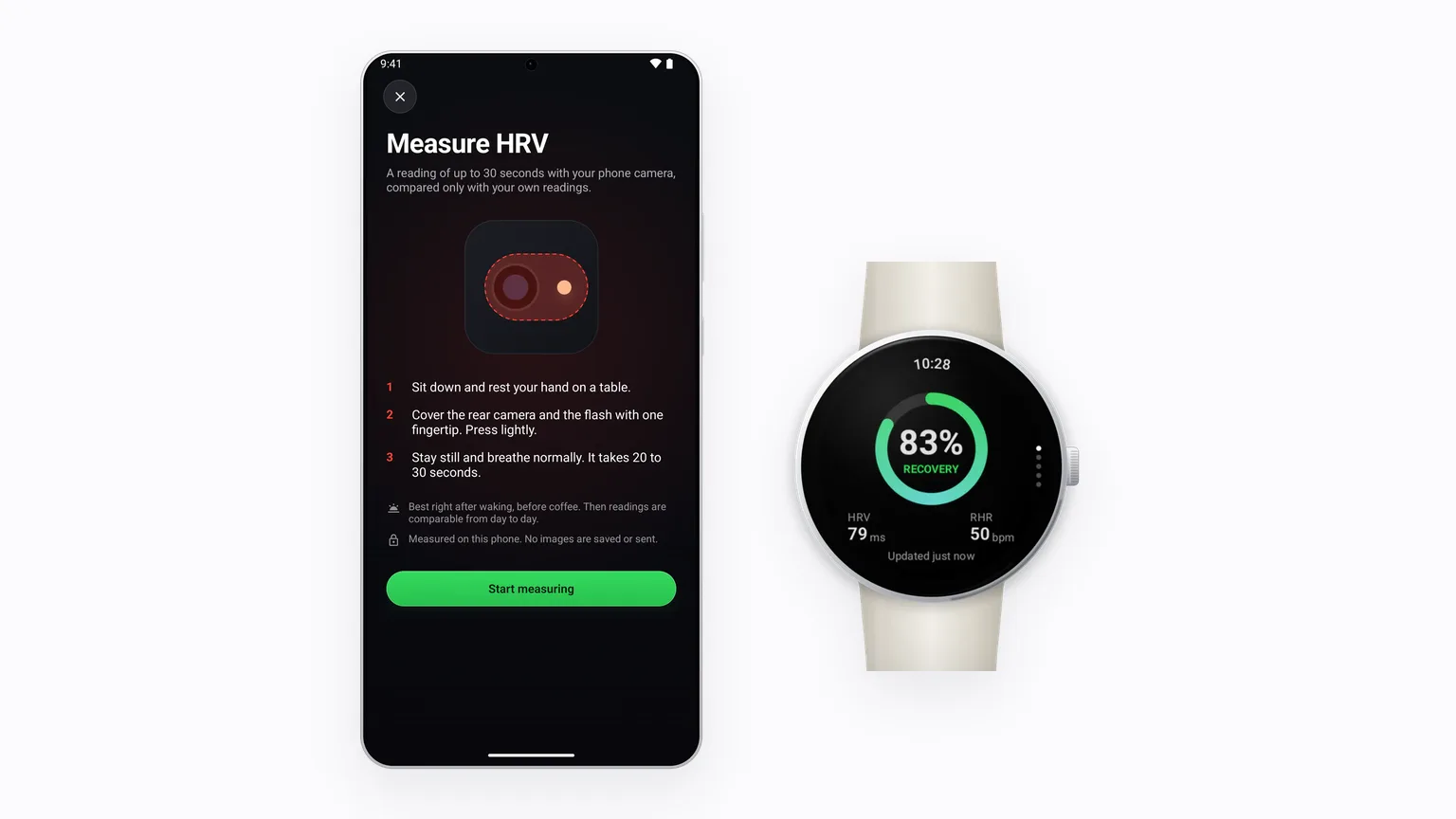
The camera option exists on Android: the Measure HRV screen takes a reading of up to 30 seconds with the phone camera and flash, processed on the phone. It is a different measurement from a watch's overnight value, which is why it is compared only with your own camera readings or an RMSSD reference.
Recovery score with HRV and without it
When HRV and resting heart rate both have a baseline, the weights are HRV 50%, resting heart rate 30%, sleep 20%. When a signal is missing, its weight moves to the remaining ones in proportion:
| Available inputs | Weights |
|---|---|
| HRV, resting HR, sleep | 50% / 30% / 20% |
| Resting HR and sleep (no HRV) | 60% / 40% |
| HRV and sleep (no resting HR) | 5/7 / 2/7 |
| No heart data | Sleep and the daily check-in rating |
The HRV component is the ratio of today's value to the baseline, clamped to 0.5 to 1.5, minus 0.5. The resting heart rate component is the ratio to its baseline, clamped to 0.85 to 1.15, as (1.15 minus ratio) divided by 0.3. Sleep uses the sleep score divided by 100, or 70 when there is no sleep data. Short sleep also caps the result: under 4 hours of sleep limits recovery to 40, under 5 hours to 60.
Worked example (illustrative numbers, not a real person)
Invented inputs: HRV 52 ms against a baseline of 60 ms, resting heart rate 56 bpm against 58 bpm, sleep score 80, 7.5 hours asleep (no cap).
With HRV:
- HRV: 52 / 60 = 0.8667, minus 0.5 = 0.3667
- Resting HR: 56 / 58 = 0.9655, so (1.15 minus 0.9655) / 0.3 = 0.6149
- Sleep: 0.80
- Total: 0.5 x 0.3667 + 0.3 x 0.6149 + 0.2 x 0.80 = 0.1833 + 0.1845 + 0.16 = 0.5278, shown as 53
Same night with no HRV available:
- Total: 0.6 x 0.6149 + 0.4 x 0.80 = 0.3690 + 0.32 = 0.6890, shown as 69
The gap of 16 points shows why a missing signal matters. With no HRV, a day with HRV 13% below baseline looks better than it would with it. The app records which basis it used (full or estimated without HRV), and the score detail shows each component and its weight.
Where this leaves a Galaxy Watch owner
If your Samsung data reaches Health Connect without HRV, Svanu still scores recovery from resting heart rate and sleep, and you can add a morning camera reading. If some source on your phone does write HRV, the app reads it as RMSSD. Svanu is still prelaunch, so none of this is a download recommendation today. Our recovery score guide explains the inputs and baselines in general. Health data from wearables is for wellness information. See a doctor for symptoms or concerns about your heart.
Frequently asked questions
Does Samsung Health show HRV?
Samsung's stress page describes a stress level based on heart rate and other factors and does not show HRV values or mention HRV. Samsung's Health Data SDK type list has no HRV entry. Samsung does not document a raw HRV screen, so check what your own Samsung Health version offers before relying on one.
Does Samsung Health write HRV to Health Connect?
Samsung does not document it. Samsung's developer guide lists the Health Connect records it maps (steps, heart rate, sleep, exercise, weight and others) and HRV is not among them. Some third-party sites say Galaxy Watch HRV reaches Health Connect, but those claims are not from Samsung. The reliable test is the Samsung Health permission screen and the app you want to read it.
Which HRV record does Health Connect define?
HeartRateVariabilityRmssdRecord. It stores one RMSSD value in milliseconds at a point in time. Google documents a valid range of 1 to 200 ms and the permissions READ_HEART_RATE_VARIABILITY and WRITE_HEART_RATE_VARIABILITY.
Is Samsung or Health Connect HRV the same as Apple Watch HRV?
Not directly. Health Connect stores RMSSD. Apple Health stores Apple Watch HRV as SDNN. The two are different statistics, so compare each against your own baseline in the same metric, never across platforms.
What happens in Svanu if my watch shares no HRV?
The Android app can use a morning camera reading as the HRV source. If there is none, the recovery score is built from resting heart rate and sleep only. The number is labeled as an estimate and the missing HRV is shown, not guessed.
Sources
- Android Developers: Health Connect data types
- Android Developers: HeartRateVariabilityRmssdRecord
- Samsung Developers: Accessing Samsung Health Data through Health Connect
- Samsung Developers: Samsung Health Data SDK, data types
- Samsung Support: Measure your stress level with Samsung Health
- Apple Developer: heartRateVariabilitySDNN
This article is for general information and is not medical advice. Svanu is not a medical device.